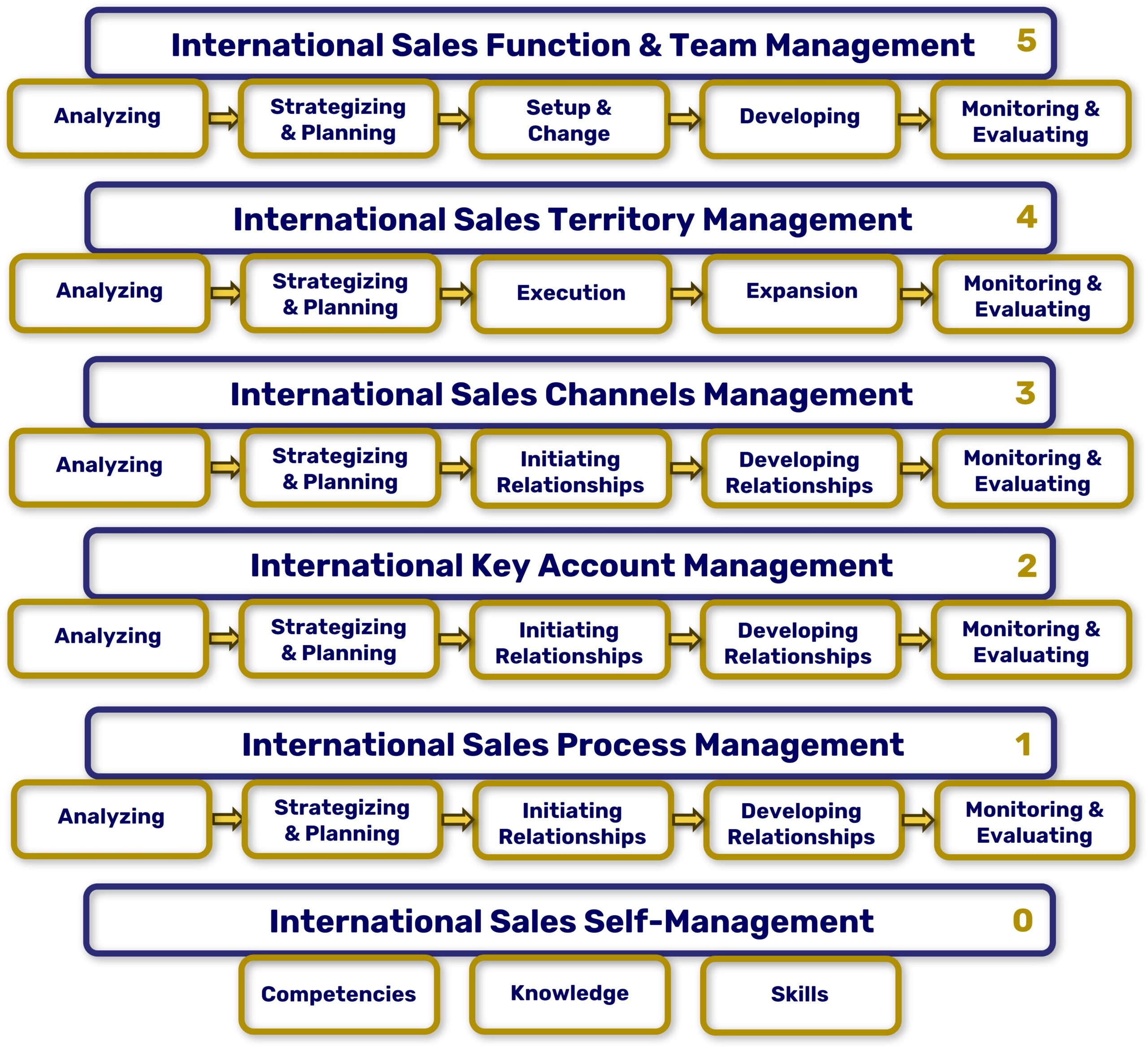
International Sales Management Profession Map (Version 3.3)

International Sales Function Analysis
Setting Sales Analysis Foundations
| Analysis objectives & benefits |
| Analysis model & domains |
| Methods & tools for analysis |
| Documenting the analysis |
Organization Analysis
| Company vision, values, history |
| Business objectives & plans |
| Business growth and competitive strategies |
| Organization structure & support mechanisms |
| Organization culture, sales attitudes & approach |
Marketing Analysis
| Marketing objectives & plans |
| Segmentation, targeting, entry mode, positioning, key differentiations |
| Brands & branding plans |
| Marketing communications, plans & activities |
| Marketing funnels, operations & automation |
| Marketing & sales collaterals & tools |
| Marketing support to sales |
| Marketing performance & ROI |
| Market sources, key information, IS |
Products & Services Analysis
| Product lines, PLCs |
| Products benefits, features and USPs |
| Product applications & use cases |
| Underlying product mechanisms & technologies |
| Related services and support (pre & post sales) |
| Products & services quality |
| Product weakness - limitation, bugs |
| Product competition / comparisons / Benchmarking |
| New products development roadmaps |
Pricing & Commercial Terms
| Pricing objectives & strategy |
| Price lists & pricing guidelines & limitations |
| Pricing adaptations, discounts, negotiation allowances |
| Commercial terms & conditions |
| Commercial agreements |
Sales Function & Strategies
| Sales objectives, targets & strategy |
| Sales quotas, settings & allocation, budgets |
| Sales approaches, processes & funnels |
| Sales playbooks & guidelines, qualification criteria |
| Sales function structure, roles and persons |
| Sales role definition, expectations & evaluation |
| Sales compensation model |
Sales Operations & Administration
| Ordering & related processes |
| Supply chain & delivering, export mechanism |
| Collection & financial controls |
| CRM, info systems, sales reporting |
Existing Customers Analysis
| Customers' common profiles & segmentation |
| Key customers profile, current sales status |
| Key customers' DMUs & contacts |
| Customer relationships, satisfaction, complaints |
| Customers related risks |
| Customers interviews - problems, needs, wants, open issues |
| Customer review visits |
| Customers' reasons for not buying |
Target Market (End Customers) Analysis
| End customers segments, sizes, trends & drives |
| End customers ideal / preferred profiles |
| End customers' problems, needs & wants |
| End customers' buying behaviour - DMU, process, factors |
Target Industry & Macro Analysis
| Target industries profiles & segmentations |
| Key competitors - companies, brands, products, customers, strengths & weaknesses |
| Industry barriers or risks |
| Legal requirements & constraints |
| Region macro environment & Trends (PESTEL) |
Sales Performance Analysis
| Sales data sources & quality - systems, reports, gaps |
| Sales figures - revenues, booking, deliveries, collections, profits |
| Sales figures - by year, quarter, month, 3 years |
| Sales figures - by region, customers, products |
| Sales trends -by country, customer, brand, product |
| Sales seasonality & industry specific contingent factors |
| Complaints analysis, satisfaction reviews |
| Current forecasts & projections |
Sales Analysis Integration
| SWOT |
| Conclusions |
| Recommendations |
International Sales Function Strategy & Planning
Sales Function Objectives & Strategy
| Sales function level forecasting |
| Sales function objectives, targets & quotas |
| Sales function strategy & fit - prioritization & focus (territories, segments, products, channels, KA, etc.) |
| Sales subsidiaries |
| Sales function during M&A |
Sales Function Planning
| Sales function - processes, funnels & lead generation |
| Sales organizational structure, responsibilities |
| Sales function guidelines and playbooks - profile, qualification, USPs. Etc.) |
| Pricing & commercial terms, pricelists |
| Sales operations & support planning |
| Sales tools & events design & planning |
| Sales trips planning |
| Sales function budget |
Sales Team Planning
| Team territories & targets allocation |
| Sales team composition, roles & responsibilities |
| Sales team expansion, re-sizing, changes |
| Sales team development & motivation plans |
| Sales team compensation |
| Ethical guidelines |
Sales Function Operations
| Sales administration |
| Sales & marketing information & leads flow |
| Sales Tech - CRM/PRM, AI, etc. |
| Coordinating: Sales-Marketing, Other |
| Sales function time tables & milestones |
International Sales Function Setup & Change
Sales Team Build-up
| Candidate profiling, criteria s& sourcing |
| Assessment, screening & selection |
| Agents & Reps & BD recruitment |
| Offer (compensation) negotiation |
Sales Team On-Boarding
| Orientation, organization training |
| Products training |
| Sales training, guidelines, tools, ethics etc. |
| Market & marketing training |
| Territory, channels, customers training |
| Sales operations, IT, Admin, interfaces training |
Initial Term Support
| Objectives & quota allocation & negotiation |
| Sales assignments allocation & follow up |
| Sales interactions support & accompanying |
Team Changes
| Turnover, firing and replacements |
Sales Operations, Enablement & Support Setup
| Processes & IS setup, skilling & assimilation |
| Sales tools production |
| Sales events preparations |
Sales Subsidiaries Set Up
| Location selection & legal set up |
| Key personnel selection |
International Sales Function Development
Sales Skills Development
| Skills development & training |
| Direction, coaching & mentoring |
| Sales creativity developing |
Sales Team Motivation
| Assessing needs, motives and drives |
| Barriers identification & removal |
| Team leadership (transformational etc.) |
| Empowering, delegation & support |
| Self-esteem and self-awareness |
| Handling rejections & burnout |
| Sales atmosphere & winning culture |
| Rewards & compensation / target adaptations |
| Career design & development support |
| Motivating remote teams |
On-going team management
| Sales team meetings (1:1, group, etc.) |
| On-going deal support, specific challenges |
| Team selling coordination |
| Coordination - sales-marketing, other internal interfaces |
Extra-Organization Developments
| Agents, Reps and outsources BD development |
| Foreign subsidiaries development |
International Sales Function Monitoring & Evaluation
Sales Function Performance Monitoring
| Measures & indicators - inputs & outputs, hard & soft |
| information sources & collection methods |
| Information levels, types & quality. Effectiveness & efficiencies (i.e. ROI) |
| Gaps and trends analysis - on-going / audit |
| Sales IS, setting dashboards & alerts |
Sales Team Reporting
| Sales IS reporting mechanism and activity |
| Sales team reporting - on-going, periodic |
| Sales function reporting to the CEO, Board etc. |
Sales Team Evaluation
| Evaluation tools |
| 360 degrees feedback |
| Performance analysis - results, behaviours, efficiencies etc. |
Sales Team Improvements
| Prioritization & improvement plan |
| Corrective actions - organization, territories etc. |
International Sales Territory Analysis
Territory Analyzing
| Territory sales performance |
| Overall territory channel structures |
| Territory account prioritization |
| Inter/intra territory conflicts |
| Country segmentation & prioritization |
| Opportunities identification |
| Territory weaknesses |
| Growth potential |
| Territory macro environment |
International Sales Territory Strategizing & Planning
Strategizing & Planning
| Territory sales forecasting |
| Territory objectives |
| Territory strategy (priority, expansion, exit etc.) |
| Inter/Intra territory synergies |
| Territory sales plan |
| Territory integrated sales funnel |
| Territory organization & resource allocation |
| Cross territory coordination |
International Sales Territory Plan Execution
Plan Execution
| Territory channel management |
| Territory key account management |
| Territory conflict management |
International Sales Territory Expansion
Territory Expansion
| Territory expansion strategies |
| Territory expansion tactics |
| Territory shrinkage & exits |
International Sales Territory Monitoring & Evaluation
Territory Monitoring & Evaluation
| Territory m&e approaches |
| Territory performance measurements |
| Territory performance dashboards |
| Gap-analysis and corrective action planning |
| Territory reporting |
International Sales Channels Analysis
Existing Int. Channels Structure
| Length, width, player types |
| Market coverage, gaps |
| Partners profile, DMUs, CBB |
| Partners potential, risks |
| Key channel partners (IKCA) |
Existing Int. Channels Relationships
| Communication, motivation |
| Trust, commitment, cooperation |
| Powers, conflicts |
| Channel complaints, satisfaction reviews |
Existing Int. Channels Management
| Objectives, strategy, leadership |
| Supports, training & programs (co-op etc.) |
| Pricing & discounts |
| Commercial terms, agreements |
| Team & capabilities |
Existing Int. Channels Performance
| Revenues, booking, deliveries, collections, profits |
| Sales - by time, region, channel type, partner, brands, product line etc. |
| Channel budgets, investment, ROI |
| Channels' current forecasts & projections |
Target Industries' Channels
| Information sources |
| Sales channels structures & tiers / supply chain |
| Sales channels player types - end users, intermediaries, vendors/producers |
| Channels buying behaviour, supplier selection |
| Non participants / facilitators players, promotional channels |
| Channels segmentation |
| Key players & their competitors |
| Competitors' channels - weaknesses, strengths |
| Channel margins, commercial terms |
| Drives & trends |
| Channel growth opportunities |
Channels Macro Ecosystem
| Political, economical, environmental |
| Social, demographics, technological |
| Channel specific legal constrains (anti-trust) |
International Sales Channels Strategizing & Planning
Int. Sales Channels Objectives & Targets
| Competitive advantage, barriers |
| Target market / segment coverage |
| Growth - new vs. existing |
| Differentiation, positioning, branding |
| Quality of Service / Delivery time / Support |
| Relationship quality |
| Sales / Profits / Growth / ROI |
| Specific partners' targets / quotas |
Int. Sales Channels Strategy
| Channels importance / leadership approach |
| Overall channels structure, key types (Dis/OEM/Agents), guidelines |
| Support intensity |
| Relationship closeness |
| Power strategy |
| Conflict management guidelines |
| Fit to higher strategies (sales, marketing, business…) |
Int. Sales Channels Planning
| Structure design (width, length, types) |
| Channels functions & roles |
| Channel partner profiling & criteria setting |
| Channel set up approaches, tactics |
| Channels set up process & timeline, milestones |
| Channels set-up / growth funnels, lead generation, conversions |
| Lead generation planning |
| Legal guidelines & terms |
| Price lists, discounts, commercial terms |
| Channel marketing programs, co-op plans |
| Channel on-boarding & training programs |
| Channels motivation principals |
| Channel support mechanisms (marketing, sales, tech, admin, logistics…) |
| Channels KA planning |
| Channel sales playbook, sales tools |
| Distribution/OEM/Agency agreements |
| Channel organization, team |
| Sales agents considerations |
| Channel management budget |
| Channel management information system |
Marketing Mix Adaptations
| Inputs to marketing - product changes / NPD |
| Inputs to marketing - pricing changes & adaptations |
| Inputs to marketing - marketing communications |
International Sales Channels Initiating Relationships
Int. Sales Channels Partners Identification
| Channel info sources identification |
| Channel set-up techniques evaluation (pull/push) |
| Initial search for channel candidates |
| Channel partners lead screening |
| Initial partner identification and evaluation |
| Partner profile adaptations |
| Partner short listing |
Int. Sales Channels Pre-Approach
| Partner intelligence collection |
| Partner screening per profile & min. criteria |
| In-depth partner analysis - business, marketing, etc. |
| Assessing needs, opportunity identification |
| Channel DMU identification |
| Channel potential, fit and barriers assessment |
| Channel value proposition design |
| Initial approach design - technique, target, script, message, sales tools |
| DMU networking, introduction, pull etc. |
Int. Sales Channels Partner Approach
| Initial contacts, opening, positive impression |
| Relaying value proposition / business opportunity |
| Stimulation & sensing interest |
| Further partner intelligence collections - discussions, meetings, networks, etc. |
| Channel buying behaviour analysis |
| Further in-depth full partner analysis |
| Partner qualification - assessing partner fit, business potential, barriers, risks, conflicts, etc. |
| Screening non qualifying partners |
| Ranking & prioritizing potential partners |
| Adapting value proposition & messaging |
| Presenting, convincing & influencing, objection handling, trust building |
Int. Sales Channels Set-up
| Information exchanges, convincing |
| Adapted partnership proposal |
| Meetings & negotiations |
| Due diligence |
| Agreement & 1st order |
| Exiting redundant negotiations |
Int. Sales Channels On-Boarding
| On-boarding detailed activity plan |
| Initial product, sales and technical training |
| Synchronising admin, logistics, purchasing |
| Personal networking & relationships |
| Agents / reps on-boarding |
Failure Analysis
| Channel barriers, conflicts, proposition, etc. |
International Sales Channels Developing Relationships
Int. Sales Channel Motivation Basics
| Channel motivation importance |
| Channel motivation challenges |
| Causes for channel motivation problems |
| Channel motivation foundations & principals |
| Setting motivation objectives |
Int. Sales Channels Initial Motivation
| Importance and challenges |
| Information collection and analysis |
| Organization and adaptation |
| Relationship building |
| Initial marketing & sales activities |
| New product introduction |
| Initial motivation of different channel member types |
| Agents initial motivation |
Channel On-Going Motivation
| Channel motivation challenges & objectives |
| Channel motivation principals & tactics |
| Channel leadership & power (inter-dependence) |
| Channel relationships development (communication, cooperation, trust & commitment). |
| Channel programming & Co-Op |
| Channel commercial support (marketing, sales, business) |
| Channel support - admin, finance, supply-chain, technical (product/customer/project) |
| Channel personal support to DMU |
| Channel training (product & sales) |
| Joint activities / partnerships |
| Identifying channels' needs, problems & opportunities |
| Channel coercion, critique and sanctions techniques |
| Channel convincing & influencing techniques |
| Channel conflict management |
| Channel adaptations (products, pricing, marcom, etc) |
| Solving channel motivational problems |
Channel Partnership Expansions
| Objectives & principals |
| Strategies & tactics |
Channel Partnership Termination
| Channels under M&A |
| Channel terminations |
International Sales Channels Monitoring & Evaluation
Channel performance monitoring & evaluation
| Monitoring & evaluation approaches |
| Channel audit system |
| On-going performance m&e |
| Overall channel evaluation (annual) |
| Channel business m&e |
| Channel motivational m&e |
| Channel relation quality & satisfaction m&e |
Channel Corrections & Changes
| Triggers & causes |
| Changes types |
| Channel changes initiation & execution |
International Key Accounts - Analysis
IKA Identification & Selection
| IKA attractiveness criteria selection & ranking |
| Setting own relative strengths criteria |
| Initial IKA candidates screening |
| Ranking candidates on criteria & strengths |
| Mapping & prioritization - IKAISM |
Internal IKAM strengths & weaknesses
| Internal resources & capabilities |
IKA Customer Specific Analysis
| External environment analysis - Micro & Macro |
| Internal environment analysis - Strategy, OBB, etc. |
| Key needs & business opportunity identification |
| Potential influence identification |
| Sales potential assessment |
International Key Accounts - Strategizing & Planning
IKAM Objectives
| Decision to adopt IKAM |
| IKAM objectives & targets |
IKAM Strategy
| Setting strategic guidelines & fit |
| Selecting target territories & verticals |
| GAM approach & strategy |
| Final IKA selection per IKAISM - who per group |
| Investment & commitment level - per group |
| IKA value proposition - per group |
| Identifying synergies |
| Critical success factors identification |
| Risk management approach & guidelines |
| Risks identifications & assessment |
IKAM Plan
| IKA program development, commercial terms |
| IKA Processes & Organization |
| Assigning KA Managers & Teams |
| IKA contacts matrix |
| Timelines and milestones |
| Adapting information systems |
International Key Accounts - Initiating Relationships
Pre-IKAM - Prospecting for IKAs
| Collecting missing intelligence |
| Stakeholders mapping |
| Assessing opportunities (i.e. current suppliers) |
| Sensing customers' interest becoming IKA |
Early IKAM - Offering & Convincing
| In-depth assessment - needs, motives, DMU etc. |
| Specific IKA value proposition development |
| Specific IKA competitive advantage development |
| Proposing IKA offer, negotiation & adaptation, |
| Identifying risks and conflict potential |
| Increasing communications, raising trust levels |
| Improving processes & cooperation |
International Key Accounts - Developing Relationships
Mid-IKAM - Preferred Supplier
| Widening & upstream DMU reach & trust |
| Reaching 'Preferred Supplier' status |
| Competitor monitoring |
| Widening inter-organizational interfaces |
Partnership-IKAM - Exclusive Supplier
| Reinforcing trust |
| Joint problem solving & NPD |
| Strategic partnership & agreements |
| Reaching 'Exclusive Supplier' status |
Synergetic-IKAM - Joint Business Planning
| Top management commitment |
| Joint R&D |
| Business transparency |
| Joint business planning |
| Joint ventures |
Uncoupling - IKAN - Relationship Breach
| Un-resolved conflicts |
| Breach of trust & commitments |
| IKAM failure analysis |
International Key Accounts - Evaluation & Monitoring
On-Going Performance (quantitative)
| Performance levels & gaps |
| KA profitability & ROI |
Overall Evaluation (Qualitative)
| Relationship satisfaction & quality |
| IKA positive impact |
| Focus & investment by IKA |
| KAMO - IKAM Orientation |
Risks Assessment
| Early signs / red flags |
| Conflicts - potential & actual |
International Sales Process - Analysis
Setting Sales Analysis Foundations
| Analysis objectives & benefits |
| Analysis model & domains |
| Methods & tools for analysis |
| Documenting the analysis |
Organization Analysis
| Company vision, values, history |
| Business objectives & plans |
| Business growth and competitive strategies |
| Organization structure & support mechanisms |
| Organization culture, sales attitudes & approach |
Marketing Analysis
| Marketing objectives & plans |
| Segmentation, targeting, entry mode, positioning, key differentiations |
| Brands & branding plans |
| Marketing communications, plans & activities |
| Marketing funnels, operations & automation |
| Marketing & sales collaterals & tools |
| Marketing support to sales |
| Marketing performance & ROI |
| Market sources, key information, IS |
Products & Services Analysis
| Product lines, PLCs |
| Products benefits, features and USPs |
| Product applications & use cases |
| Underlying product mechanisms & technologies |
| Related services and support (pre & post sales) |
| Products & services quality |
| Product weakness - limitation, bugs |
| Product competition / comparisons / Benchmarking |
| New products development roadmaps |
Pricing & Commercial Terms
| Pricing objectives & strategy |
| Price lists & pricing guidelines & limitations |
| Pricing adaptations, discounts, negotiation allowances |
| Commercial terms & conditions |
| Commercial agreements |
Sales Function & Strategies
| Sales objectives, targets & strategy |
| Sales quotas, settings & allocation, budgets |
| Sales approaches, processes & funnels |
| Sales playbooks & guidelines, qualification criteria |
| Sales function structure, roles and persons |
| Sales role definition, expectations & evaluation |
| Sales compensation model |
Sales Operations & Administration
| Ordering & related processes |
| Supply chain & delivering, export mechanism |
| Collection & financial controls |
| CRM, info systems, sales reporting |
Existing Customers Analysis
| Customers' common profiles & segmentation |
| Key customers profile, current sales status |
| Key customers' DMUs & contacts |
| Customer relationships, satisfaction, complaints |
| Customers related risks |
| Customers interviews - problems, needs, wants, open issues |
| Customer review visits |
| Customers' reasons for not buying |
Target Market (End Customers) Analysis
| End customers segments, sizes, trends & drives |
| End customers ideal / preferred profiles |
| End customers' problems, needs & wants |
| End customers' buying behaviour - DMU, process, factors |
Target Industry & Macro Analysis
| Target industries profiles & segmentations |
| Key competitors - companies, brands, products, customers, strengths & weaknesses |
| Industry barriers or risks |
| Legal requirements & constraints |
| Region macro environment & Trends (PESTEL) |
Sales Performance Analysis
| Sales data sources & quality - systems, reports, gaps |
| Sales figures - revenues, booking, deliveries, collections, profits |
| Sales figures - by year, quarter, month, 3 years |
| Sales figures - by region, customers, products |
| Sales trends -by country, customer, brand, product |
| Sales seasonality & industry specific contingent factors |
| Complaints analysis, satisfaction reviews |
| Current forecasts & projections |
Sales Analysis Integration
| SWOT |
| Conclusions |
| Recommendations |
International Sales Process - Strategizing & Planning
Setting International Sales Targets
| Country / region sales forecasting |
| Receiving & negotiating sales targets / quotas, budgets |
| Target Matrix, timeline & milestones |
Formulating Sales Strategy
| Receiving Strategic guidelines |
| Sales approach |
| Growth strategy - new vs. existing |
| Targeting & prioritizing - regions, segments, industries, customers |
| Crystalizing USPs vs key competitors |
Sales Planning
| Sales funnel design - stages, targets & metrics, conversions, cycles |
| Quota attainment tactics & contingencies |
| Setting ideal customer profiles, DMU targets |
| Setting qualification criteria (i.e. BANT etc.) |
| Setting MQL requirements - quality & quantity |
| Planning sales budget allocations |
| Setting other prerequisites and needs (org / marketing) |
| Sales activities timeline planning |
| Regional sales plan on-going updates |
Sales Preparations
| Product changes reviews |
| Playbook update & adaptations |
| Sales tools & decks updates, adaptation |
| Price lists & commercial terms updates, adaptation |
| Negotiation rules, allowances & red-lines adaptation |
| Commercial agreements updates, adaptation |
| Synchronizing with marketing, relaying requirements |
| Synchronizing with service & support |
| Synchronizing with supply chain and deliveries |
| Information system updates, adaptations |
International Sales Process - Initiating Relationships
Identifying Potential Customers (leads)
| Identifying leads sources |
| Receiving Inbound leads |
| Market / industry scanning |
| Identifying potential outbound leads |
| Identifying RFI's, tenders / commercial calls |
| Initial leads evaluation |
| Leads selection & prioritization |
Pre-Approach
| Collecting initial customer intelligence |
| Initial needs assessment |
| Focusing benefits, value & ROI |
| Analysing potential competition, focusing USPs |
| Sales potential & efforts evaluation |
| DMU Mapping, entry points, path |
| Approach objective, planning & tactics |
| Approach messages, script design |
| DMU networking |
Initial Approach(es)
| Initial contact & opening |
| Positive impression |
| Building Awareness |
| RFI Response |
| Stimulating initial interest |
| Questioning - needs, wants, expectations |
| DMU verification & manoeuvre |
| Understanding current state / solution |
| Evaluating alternative & competitive solutions |
| Urgency & budget assessment |
| Benefits, Value, USPs adaptations (on-the-fly) |
| Relaying value, reception verification |
| Call to action, agreeing on next steps |
Assessments & Adaptations
| Collecting additional intelligence |
| Buying behaviour analysis - process, criteria, risks |
| DMU & needs & wants re-assessment |
| Value gaps assessment & adjustments |
| Sales style & process adaptations |
| Qualification & potential assessment |
| Identifying & handling objections |
| Coordinating team's sales efforts |
On-Going Interactions
| Questioning - missing information, buying process, bottlenecks, barriers etc. |
| Relaying messages & information to DMU |
| Follow ups, on going trust & value buildup |
Presenting, Influencing & Convincing
| Presenting value, benefits, USPs, ROI, vision |
| Presenting solutions, products, technology, quality |
| Presenting competitive advantages |
| Presenting company, brand & capabilities |
| Presenting limitations and disclaimers |
| Presenting commercial issues, pricing |
| Demonstration & proofing |
| Using marketing & sales tools |
| Answering inquiries and questions |
| Non-formal influencing & convincing |
Offering & Building commitment
| Initial proposal formulation, internal feedback |
| Proposal / Quotation / RFP respond |
| Tendering / Bidding |
| POC / Trials / Piloting |
| Personal relationship bonding |
| Proposal negotiation & persuasion |
| Proposal adaptations |
| Proposal follow ups |
| Agreement / contract negotiations |
| Closing - orders / agreements |
Failure analysis
| Sales process gaps and dropouts |
| Communications & trust analysis |
| Proposal vs. needs & wants gaps |
International Sales Process - Developing Relationships
Customer On-boarding
| Customer success objectives & KPIs |
| Delivery coordination |
| Order fulfilment - delivery & installation |
| Implementation and initial support |
| Customer usage training |
Customer On-Going Relationship
| On-going communications & interactions |
| Problems, complaints, conflicts |
| Service recovery & conflicts resolutions |
| Maintaining satisfaction |
| Nurturing personal relationships |
| Maintaining & building trust |
| Getting referrals & introductions |
Customer Share Expansion
| Identifying additional needs & opportunities |
| Increasing usage and # of users |
| Added services & add-ons |
| Value adaptations & expansion (up-sell / cross-sell) |
| New product design & development partnerships |
International Sales Process - Monitoring & Evaluation
Monitoring & Evaluation
| Sales performance management methodology |
| Sales performance management tools & technologies |
| On-going performance monitoring |
| Sales performance analysis & evaluation |
| Sales performance reporting |
| Identifying key regions, segments customers (ICP), etc. |
| Corrective action - planning and execution |
International Sales Self-Management - Competencies
Foundation Competencies
| Self analysis & reflection |
| Self-awareness |
| Self development approaches & techniques |
| Customer orientation & understanding |
| Credible, reliable, trustworthy |
| Courteous, Respectful, Emphatic |
| Internal motivation |
| Determination & persistence |
| Overcoming fear of rejections |
| Adaptation & flexibility |
| Self-regulation |
| Ethical & moral |
Sales Communications Competencies
| Corresponding, mailing, texting |
| Cold calling, phoning |
| Questioning (Sandler, SPIN) |
| Active listening & observation |
| Giving information / messaging |
| Persuasion / convincing / Influencing |
| Storytelling |
| Presenting - in person & remote |
| Reading people |
| Non-verbal Communications |
| Reporting |
| Follow Up |
Sales Interpersonal Competencies
| Networking |
| Meetings |
| Coordination & cooperation |
| Team working |
| Building trust & personal connection |
| Leadership & motivating |
| Building power |
| Managing conflicts |
| Negotiating |
| Training & consulting |
| Mentoring & coaching |
| Handling interferences |
| Handling timewasters |
| Handling micro management |
| Manging your manager |
Sales Intercultural Competencies
| Cultural sensitivity |
| Cultural values |
| Specific cultures |
| Cultural adaptation |
| Cross-cultural communications |
| Business etiquette |
| Business English |
| Other languages |
Self Management Competencies
| Personal vision & targets |
| Forecasting & planning |
| Managing time & activities |
| Prioritizing |
| Focusing |
| Managing procrastination |
| Decision making |
| Problem solving |
| Handling change |
| Stress / LWB |
International Sales Self-Management - Knowledge
Own Company Knowledge
| Business objectives & strategy |
| Marketing objectives, strategy |
| Marketing plans, activities, resources |
| Sales objectives & strategy, plans, processes |
| Solutions, Products & Services |
| Underlying Technologies |
| Product Application & Demonstration |
| Own Company organization & resources |
| Ordering, delivery & logistics |
| Customer service & support |
| Customer complains & satisfaction |
| Sales Operations, Automation, IT |
Sales Context Knowledge
| Customers Needs & Wants, Pain Points |
| Customers' business objectives & strategy |
| Customers' organization & resources |
| Customers' buying behaviour, DMU etc. |
| Macro environment & trends |
| Markets, segments, trends |
| Industry & competitors |
| Channels ecosystem |
| Value Proposition, USPs, Benefits, ROI |
| Sales approaches |
| Sales trends |
| Sales Tech |
Int. Marketing Knowledge
| Int. marketing principals |
| Market research & analysis |
| Market information sources |
| Customer value & satisfaction |
| Marketing strategy & planning |
| Whole product concept |
| Service marketing & QoS |
| Pricing & price adaptations |
| Marketing channels management |
| Marketing communications |
| Marketing & sales tools |
| Advertising & PR |
| Trade shows & events |
| Sales promotions |
| Digital marketing |
| Demand, lead, funnels |
| Marketing automation & Mar-tech |
| Marketing support |
| Marketing ROI |
| AI for Int. marketing |
Int. Business knowledge
| Business analysis |
| Organizational behaviour |
| Business strategy & planning |
| Financial management |
| Supply chain management |
| Project management |
| Legal, regulations |
| International trade - export, imports, INCOTERMS |
| Business information systems |
| International standards & verification |
| AI for int. business |
International Sales Self-Management - Skills
Other Skills & Competencies
| Strategic Thinking |
| Critical Thinking |
| Creativity |
| Handling difficult customers |
| Crisis sales management |
| Women in international sales |
| Business travel |
| Traveling abroad, driving |
| Seeking & analysing Information |
| Calculus & Statistics |
| ICT Literacy / Digital Skills |
| AI Literacy |
| Safety & security |
| Handling corruption |
Level 5 - International Sales Function & Team Management
ISM Level 5 - Managing the organizational international sales function focuses on achieving the business’s overall sales targets.
The task is to develop the organization, its resources, processes, and capabilities in order to generate growing revenues over time, while addressing the continuous changes in the organization’s internal and external business environment.
Level 4 - International Sales Territory Management
ISM Level 4 - This management level focuses on achieving the overall sales targets for a defined international territory.
Such a territory may include several countries or an entire geographic region and may encompass different types of customers from various market segments and/or industries operating in the territory at the same time.
Ideally, the goal is to synchronize the various sales efforts across the territory as much as possible in order to create synergy, so that the territory’s sales operation is not only effective but also efficient in achieving significant sales targets.
Level 0 - International Sales Self-Management
ISM Level 0 - Self-management is a person’s ability to regulate their behaviors, thoughts, and emotions in a way that better serves both them and their work.
Success in international sales depends heavily on the performance of international sales managers at every management level.
Their knowledge, experience, capabilities, skills, behavior, and other attributes have a major impact on both their own sales performance and that of the organization as a whole.
Level 3 - International Sales Channels Management
ISM Level 3 - This management level focuses on international sales channels as an integrated system designed to generate significant, sustained revenue for the business.
Sales channels are a valuable—and sometimes strategic—company asset, so managing them as such requires an appropriate strategy and capabilities.
Level 2 - International Key Account Management
ISM Level 2 - This management focuses on preferred international customers. In international sales, companies sometimes choose to focus on specific customers because of their importance to the business, the revenue they generate, and the desire to develop meaningful—and sometimes strategic—relationships with them. These customers are often referred to as Key Accounts.
These may be end customers, distribution customers, or other manufacturers (for example, under OEM arrangements). What matters is focused, in-depth management of a limited number of selected customers, guided by a specific strategy and plan.
Level 1 - International Sales Process Management
ISM Level 1 - This is the basic international sales process, focused on acquiring customers and developing relationships with them in order to achieve the established sales targets.